The Story Behind Echoes of the First Fire
Echoes of the First Fire grew out of something I have always found interesting about mythology. Cultures separated by enormous distances and long periods of time somehow end up telling stories that seem to be wrestling with many of the same human impulses.
Joseph Campbell and comparative mythology were part of what got me thinking about that. I became especially interested in stories where humanity receives, steals, discovers, or otherwise gets access to something transformative. Fire is the obvious example, but underneath the fire you also find knowledge, power, curiosity, rebellion, discovery, and the crossing of boundaries.
The first version of the song made those connections much more obvious.
Eventually that started working against the idea.
I did not really want to write a song explaining mythology. What interested me was why we keep telling versions of these stories in the first place. So I rewrote the song and pushed most of the mythology beneath the surface.
Fire became embers, stone, glass, wire, storms, memory, patterns, light, and old forces appearing again in new forms. Someone should be able to hear the song without knowing anything about comparative mythology and still recognize the larger pattern.
That was where the connection to modern technology became much clearer for me.
Learning to control fire was technology.
From there, humanity never really stopped. We made better tools. We built machines. We harnessed electricity. We developed electronics, computers, networks, and eventually artificial intelligence.
Every generation seems to discover another version of fire.
Each one changes what is possible, and each one introduces consequences that are difficult to understand before we are already living with them.
I do not see that as a simple story about technology being good or technology being dangerous. Usually it is both. New capabilities solve problems, create other problems, threaten assumptions, expand what people can do, and eventually become normal enough that we start reaching for the next thing.
Maybe that is one reason those ancient stories continue to work.
The characters change. The technology changes. The consequences change.
The impulse does not.
Human beings reach.
Sometimes we get burned. Sometimes we create something extraordinary. Quite often we do both.
Echoes of the First Fire became my way of looking at that recurring pattern, from ancient stories around literal fire all the way to technologies that would have seemed indistinguishable from magic to almost everyone who lived before us.
Creative Notes
The song actually began as an idea for Sivra Dark. That was the creative environment where much of the early mythology, heavier musical direction, and visual experimentation developed. It was never released as a Sivra Dark song.
The earliest concept grew directly from Joseph Campbell, comparative mythology, recurring archetypes, and Hero’s Journey thinking. Early drafts made the mythological parallels explicit, including figures such as Prometheus, Raven, Coyote, and Maui.
That approach eventually felt too literal. I wanted the underlying pattern to remain without requiring the listener to recognize a list of ancient stories. The song received a substantial symbolic rewrite that was informally thought of during development as the “Veiled Form.”
The rewrite replaced much of the explicit mythology with recurring images of fire, embers, stone, glass, wire, storms, memory, patterns, and light. The myths became source material rather than the literal subject of the finished song.
The musical development took an equally indirect route.
A recurring problem in Suno was that the song kept feeling slower than I wanted. Simply increasing the tempo or making the drums and instruments move faster did not solve it. The vocalist would continue stretching the phrases across the arrangement, so the performance still felt slow.
That distinction became important. I did not simply need faster music. I needed the singing itself to move.
The vocal experiments moved away from a low, theatrical baritone and toward a much higher, more dynamic metal performance. Since the singer was AI generated, I also started experimenting with the idea that the vocalist did not necessarily need to obey ordinary human physical limitations. That opened up possibilities such as unusually large range, rapid register changes, enormous dynamic shifts, layered vocal textures, clean power, grit, and transitions that would be extremely difficult for one human singer to reproduce consistently.
Those experiments briefly led to the idea of creating an entirely new heavy metal Artist called Aetheron Prime. That was an exploratory branch rather than the final home for the song.
Ultimately I pivoted the song to Zed Wishless.
That was the release that actually happened. Echoes of the First Fire was released under Zed Wishless, not Sivra Dark and not Aetheron Prime. The earlier Artist ideas remain part of how the song developed, but Zed Wishless is the canonical Artist for the finished release.
The artwork followed the same evolution. Early Sivra Dark development explored more cinematic symbolic imagery using teal, amber, copper, warm gold, hidden figures, fire, and the intersection of ancient and technological forms.
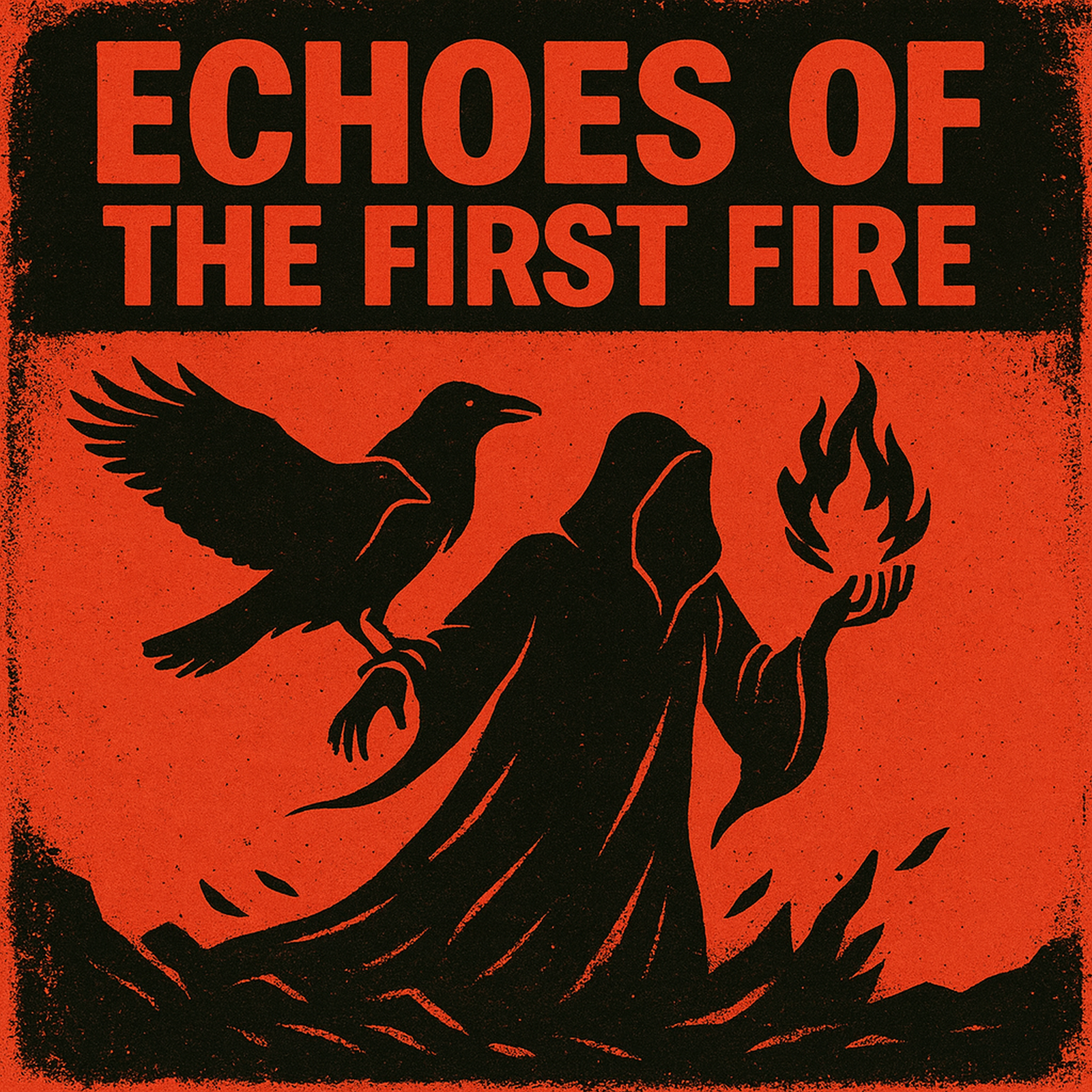
Once the song moved to Zed Wishless, the visual identity changed with it. The finished direction adopted the established red-and-black Proctor Valley Days-inspired Zed Wishless motif, with distressed screen-print textures and symbolic fire imagery. That treatment became part of the actual Zed Wishless identity of the release rather than simply an alternate mockup.
The song is conceptual and philosophical rather than autobiographical. The source material is comparative mythology, human history, technological development, and observation of recurring patterns in human behavior.
Looking back at the song now, I can also see an idea forming here that later became much more explicit in Nebula’s Pulse. Echoes of the First Fire was created well before We Found the Switch in my song sequence, and I did not consciously connect the two at the time. But the underlying question was already there: humanity repeatedly discovers another form of “fire,” gains access to something that changes what is possible, and then has to live with what it has unleashed. We Found the Switch eventually took that same line of thought into a much more literal science-fiction direction. In retrospect, Echoes feels like an early philosophical precursor to that world.
Lyrics
Listen & Follow
Play the song while you follow the lyrics.
We were shadows tracing circuits In the dark before the dawn Hands of hunger, eyes of wonder Writing names we can’t recall Through the glass and into memory Every spark becomes a sin We built a heaven out of embers And called it light again
We are echoes of the first fire Born from the void’s desire Every soul a flare that climbs Every fall repeats the rhyme Through the stone, the wire, the storm We keep the pattern warm
In the hum beneath the silence Something old begins to stir The wind remembers languages That no tongue can confer We breathe the pulse of what was lost And dream the shape of what remains The light that burns without a source Still dances in our veins
In the forge of every ending In the calm before the flame We forget who lit the kindling And swear it’s ours again
We are echoes of the first fire Bound to rise and to aspire Every dream that dares the sky Knows the cost to fly Through the flesh, the code, the storm We keep the pattern warm
Still we reach, still we burn Still we build the fire we learn
💬 Comments & Discussion
Comments are powered by GitHub Discussions. You'll need a GitHub account to participate.