The Story Behind Meridian Overlook
Meridian Overlook began during a day of exploring the mountain and forest roads outside Ashland, Oregon.
Much of the drive had been enclosed by the landscape. The road wound along steep mountainsides, through mixed evergreen forest, madrone, shaded areas where the temperature dropped noticeably, dusty stretches, small meadows, and trails that seemed to keep branching farther into the mountains. It was the kind of exploration where the surroundings change gradually enough that it can be difficult to notice how much elevation and distance have accumulated.
Eventually the road reached Meridian Overlook.
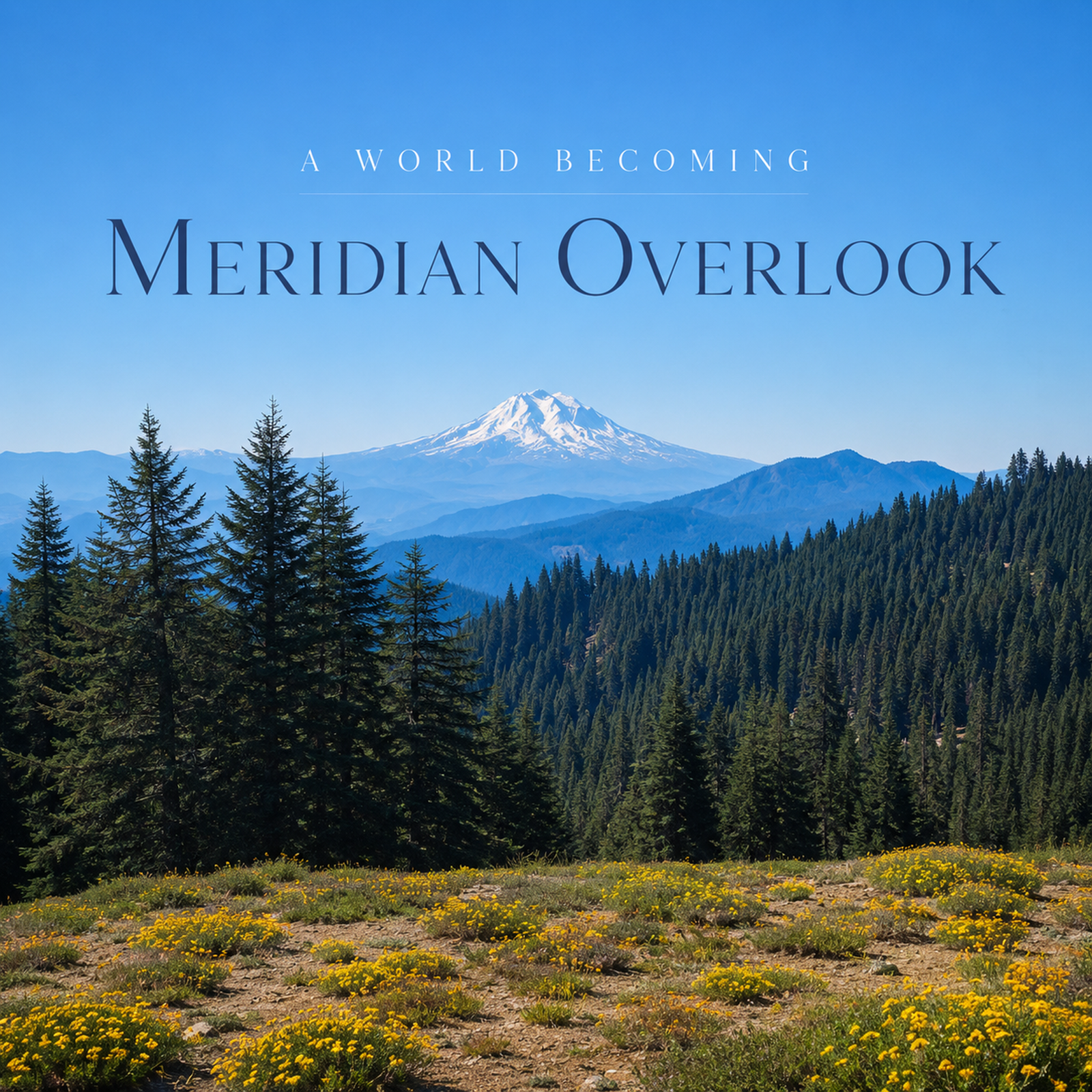
The view suddenly became enormous. Instead of looking into the forest or across the side of the next mountain, the landscape opened in both directions. Layered ridges stretched across the distance, and Mount Shasta was clearly visible across the valley. The day was somewhat hazy, but the haze did little to diminish the scale of the view. If anything, it made the mountains appear to recede through successive layers of distance.
That transition became the idea for the music. Meridian Overlook was conceived as an ambient journey that begins relatively enclosed and intimate, then gradually opens as though the listener is gaining elevation and finally arriving at the overlook. The destination is not presented as a dramatic conquest. It is a change in perspective, the quiet realization that the world has become much larger than it appeared a few minutes earlier.
Creative Notes
The development of Meridian Overlook became an opportunity to bring cello much more deliberately into A World Becoming. I had recently developed a much stronger appreciation for the instrument and had been looking for the right piece to integrate it into. This composition finally felt like the natural fit. The cello could carry the searching, grounded quality of the earlier sections while the surrounding strings expanded with the landscape.
Several production directions were explored around that core idea, including cello-forward strings, chamber orchestra expanding into full symphony, broader orchestral arrangements, and restrained choir or angelic wordless female vocals during the panoramic sections. The goal throughout was to let the music become larger without turning the overlook into an oversized cinematic climax.
The cover artwork was developed from photographs taken at Meridian Overlook that day. The photographs included the distant Mount Shasta view, layered ridges, forest, and foreground vegetation. The visual interpretation was allowed to reduce the real-world haze and emphasize the openness and depth of the location rather than reproduce the photograph literally.
Lyrics
Listen & Follow
Play the song while you follow the lyrics.
Instrumental.
💬 Comments & Discussion
Comments are powered by GitHub Discussions. You'll need a GitHub account to participate.