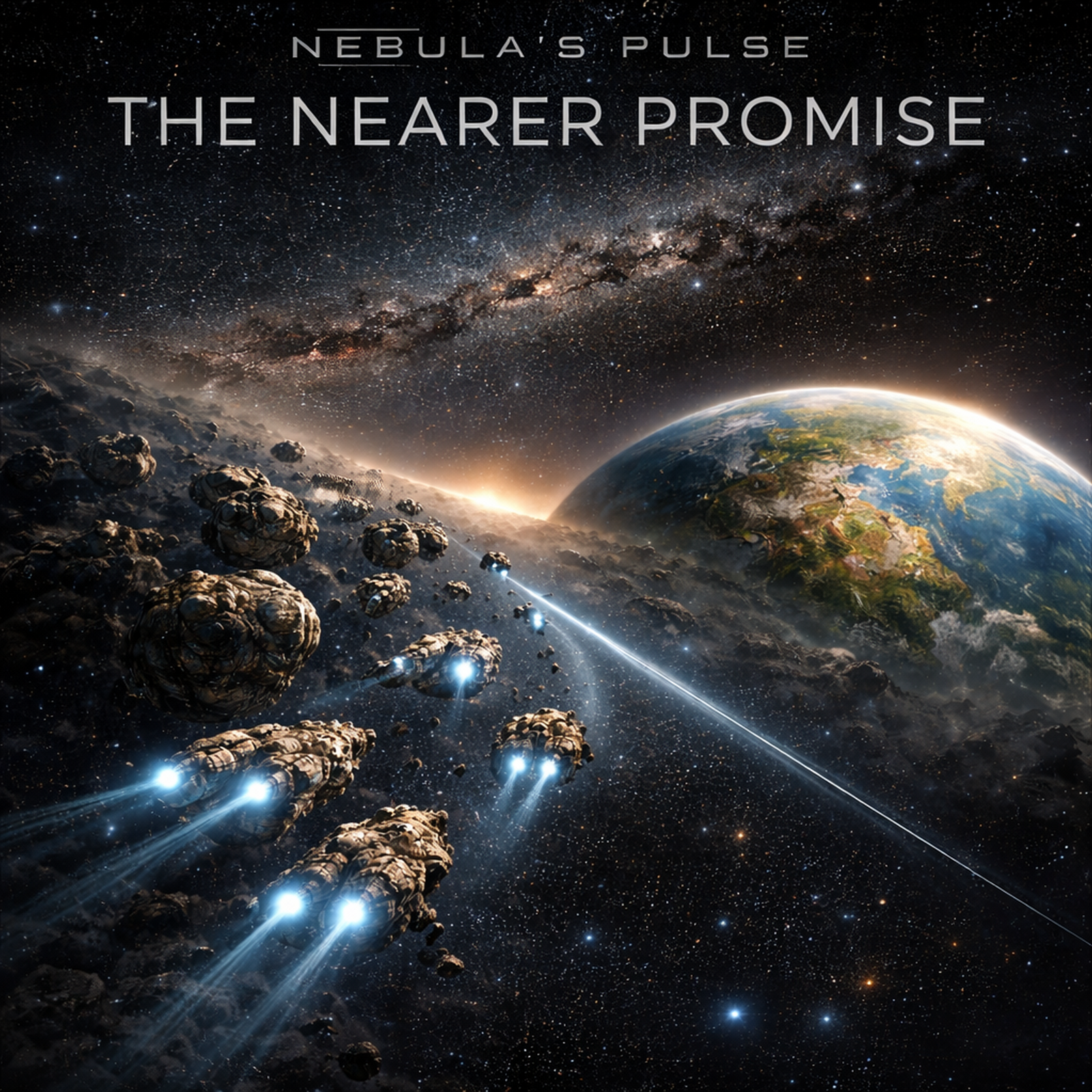
The Story Behind The Nearer Promise
Asha’s Bearing leaves humanity with an extraordinary observation.
The ancient material aboard the fleet appears to behave more efficiently along a particular direction through space. The effect is subtle enough that it cannot honestly be called a message. There is no voice directing humanity, no prophecy, and no promise that following the bearing will lead anywhere at all. There is only a measurable pattern.
Then humanity finds something much easier to understand.
A star system lies significantly away from the bearing, and the available observations suggest it may contain a world within the conditions needed for life. After everything humanity has survived, the possibility is difficult to ignore. A potentially habitable planet offers something immediate that an unexplained direction cannot: a place to investigate, perhaps settle, and perhaps finally stop searching.
The fleet debates the choice and ultimately turns toward it.
At first, the decision seems entirely reasonable. Nothing prevents them from changing course. God Material does not react dramatically, and no disaster follows. But over time, engineers begin seeing a pattern in the numbers. Systems that had operated with unusual efficiency require more energy. Stability decreases. The difference is not severe enough to threaten the fleet, but it is persistent enough to become difficult to dismiss.
Eventually they decide to test the obvious possibility.
The fleet turns back toward Asha’s Bearing.
Efficiency improves.
That simple result changes the meaning of the original discovery. Humanity has now moved away from the bearing and returned to it by choice, and the material has responded predictably both times. Whatever Asha’s Bearing represents, it is not merely an interpretation imposed on random data.
The Nearer Promise is important because nobody is punished for investigating the alternative. The possible world was worth considering. The decision to explore it was defensible. Humanity learns by testing the universe rather than by blindly accepting what it finds.
Even after the experiment, they still do not know where Asha’s Bearing leads or why God Material responds to it. They have only established that the relationship appears to be real.
For the Nebula’s Pulse story, that distinction matters. The universe is becoming stranger, but humanity is still approaching that strangeness through observation, argument, experimentation, and the willingness to change course when the evidence changes.
The nearer promise offered a destination.
Asha’s Bearing remains only a direction.
For now, the direction is enough.
Creative Notes
The Nearer Promise was developed specifically to test the idea introduced in Asha’s Bearing rather than simply repeat it. The story needed humanity to make a meaningful choice against the bearing so the phenomenon could produce observable evidence.
An important constraint was that God Material could not become a supernatural guide. It does not speak, provide visions, identify a chosen destination, or punish the fleet for deviation. Its directional preference is expressed through measurable changes in coherence, stability, and efficiency.
The alternative destination was therefore designed to be genuinely reasonable. A significantly off-bearing system with a potentially habitable, Goldilocks-like world gave humanity a credible reason to investigate. The deviation is a scientific and human decision, not a moral failure.
The correction was also intentionally non-catastrophic. Performance degrades gradually enough for the fleet to recognize a pattern, debate its meaning, and voluntarily return to the original course. Improvement after the correction provides the experiment’s second data point.
The title The Nearer Promise emerged from that tension. It carries a faint mythic or biblical resonance without turning the story into an allegory about temptation or sin. The closer possibility promises something humanity already understands, while Asha’s Bearing asks them to continue toward something they do not.
Later Nebula’s Pulse worldbuilding makes the experiment more significant. Concepts such as the Signal Field, the Nine Fields, and Coherence provide a larger framework in which directional alignment and changing system behavior can eventually be understood. Those ideas expand the implications of The Nearer Promise, but they were not necessary for the original chapter to work. At this point in the story, humanity has evidence of a relationship without yet possessing the science needed to explain it.
Lyrics
Listen & Follow
Play the song while you follow the lyrics.
We set our course by what aligned By quiet gains we couldn’t find In charts or faith or spoken creed Just less correction less we’d need
The numbers closed the margins grew The engines hummed like they once knew No signal called no voice appeared Just things that worked when we were clear
Then came a world that looked like rest A softer light a nearer test Within the band where life might stay Close enough to make the case
We argued calm we weighed the cost What we might gain what might be lost No vow was broken none betrayed We turned to see what promise made
It didn’t fail it didn’t break It only asked for more to take More power burned more time was spent More strain in what the systems meant
Nothing warned nothing cried The only change was deep inside What once was free now came at cost The nearer promise took its toll
The drift was slow the loss was thin But every gain took more to win The god material held its form Yet asked for hands to keep it warm
No fault was named no blame was thrown The truth appeared in trends alone What worked before now asked too much We felt the loss in every touch
So we returned not shamed not bowed No lesson preached no verdict loud We set again the earlier line And watched the margins realign
No gift was given none returned Just quieter systems less we burned Not all that shines is meant to stay We left behind the nearer promise
Some paths are close But not our way
💬 Comments & Discussion
Comments are powered by GitHub Discussions. You'll need a GitHub account to participate.