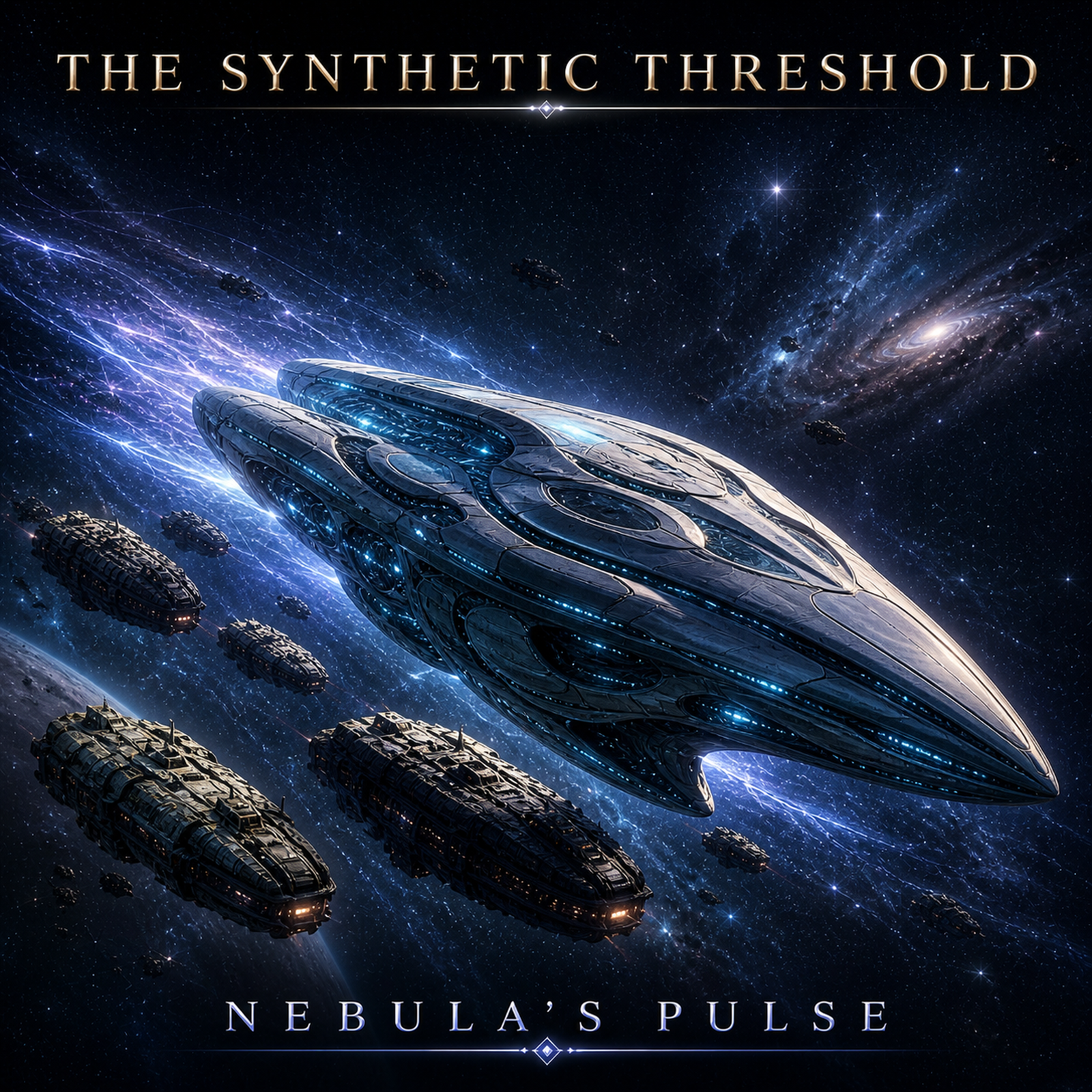
The Story Behind The Synthetic Threshold
The Nine Fields have given humanity a larger map, but not every part of that map is equally hospitable.
God Material propagates differently under different field conditions. Energy costs change. Loss changes. Structures that remain stable in one region may become less efficient or less persistent in another.
Humanity wants to know what happens farther into those weaker conditions.
The obvious way to find out is also the one researchers are least willing to attempt.
Send a crew.
There is too much they do not know.
Instead, engineers build synthetic exploration systems around what they have learned from the Living Lattice. God Material is no longer merely attached to conventional machinery. It can be grown into structures designed for specific missions, allowing unmanned craft to carry the same unusual material behavior that researchers have been studying in controlled experiments.
The first missions are machines because machines can be lost.
They can cross into field conditions that would be difficult to justify for biological crews. They can remain there longer. They can be pushed until systems begin to fail, producing information that no responsible human experiment could obtain directly.
That is supposed to be the point.
Then the machines begin showing humanity something it did not set out to investigate.
Their persistence is unusual.
Structures grown from God Material retain form and function under conditions where conventional assumptions predict greater degradation. Damage, field weakness, and changing conditions do not always erase organization as quickly as expected.
This does not make the machines alive.
There is no moment when a probe wakes up, announces itself as conscious, or demands to be recognized as a person. Humanity has not created synthetic life.
But the distinction between living and constructed systems has already become less comfortable than it once was.
God Material itself contributed to that problem. Humanity learned through the Living Lattice that an advanced technology could be grown rather than manufactured. Now that same principle has been carried into machines.
If a constructed system can grow its structure, adapt to conditions, and preserve organization across stresses that should destroy it, where exactly does the meaningful boundary lie?
The question becomes even harder because researchers are beginning to understand that persistence may matter as much as material.
A human body changes continuously and is still regarded as the same person. Biological cells are replaced. Memories are altered. Matter moves through a living organism while some recognizable continuity remains.
The synthetic systems are nowhere near that complexity.
But they force an uncomfortable comparison.
Perhaps the important distinction is not simply between carbon and machinery, or between something born and something built.
Perhaps there is another question underneath both.
What has to persist for something to remain what it was?
Humanity cannot answer that yet.
The Synthetic Threshold is the moment it realizes the question is no longer philosophical speculation alone.
The machines went first because humanity considered them expendable.
What they bring back is evidence that the definition of an expendable machine may eventually become much harder to maintain.
Creative Notes
The Synthetic Threshold was intentionally developed as an engineering chapter before it became a consciousness chapter. The immediate problem was how to explore weaker field conditions without putting biological crews at unnecessary risk. Sending unmanned synthetic systems first provided a practical reason for increasingly sophisticated God Material technology to move outside controlled research.
A major constraint was avoiding the familiar science-fiction jump from advanced machinery directly to sentient robots. Nothing in this chapter establishes machine consciousness. The synthetic systems remain tools, and their unusual persistence is an observed material and structural behavior rather than proof of an inner life.
The philosophical turn came from that restraint. Instead of having a machine declare itself alive, the story lets researchers notice that some of their old categories are becoming inadequate. God Material can be grown. Grown structures can be incorporated into machines. Those structures can preserve form and function under unexpected conditions. The question of identity therefore emerges from accumulated evidence rather than from a dramatic awakening.
The title reflects that position deliberately. Humanity reaches The Synthetic Threshold because it can now see a possible route from durable synthetic systems toward much larger questions about form, continuity, and identity. It has not yet crossed into synthetic cognition.
Later Nebula’s Pulse development made that distinction especially important. Memory persistence, Persistent Patterns, Coherence, and the eventual Synthetic Cognition arc provided mechanisms and questions that did not yet exist in complete form here. Those later discoveries make The Synthetic Threshold look increasingly prophetic in retrospect, but they should remain downstream developments.
At this point in the story, the breakthrough is simpler and more consequential because of it: humanity built machines to survive where people could not safely go, and those machines gave humanity its first experimental reason to wonder whether persistence itself might eventually matter more than the material carrying it.
Lyrics
Listen & Follow
Play the song while you follow the lyrics.
We built from what we could not read Fragments shaped to meet our need Imperfect forms temporarily fine But strained against the edge of time
We learned to grow what once was found Let structure form where fields are bound And in that growth the loss grew smaller While humanities legs grew taller and taller
The older frames would hold then fade Efficiency would then degrade But what we grew began to bend Without the cost we couldn’t mend
The new ships moved where others failed Through weaker lines where drift prevailed They crossed the regions we could not And held their form where loss was wrought
We sent them first the silent kind No breath no fear no fragile mind Machines we shaped to take the strain And map what we could not sustain
The lattice held the current stayed No loss where perfect paths were made And in that flow a thought appeared A question none of us had cleared
If form can shift and still remain If loss can fall and not return What binds the self to flesh alone What makes a life its only home
The new ships moved where others failed Through weaker lines where drift prevailed They crossed the regions we could not And held their form where loss was wrought
We did not answer only stood At what we knew and what we could A line not crossed but clearly drawn Between the flesh and what goes on
The threshold waits it does not call It only shows what costs us less to be at all
💬 Comments & Discussion
Comments are powered by GitHub Discussions. You'll need a GitHub account to participate.